4. One DEFLATE body, three format paths
d5c1fe8e93657430 · Source at the matching commit ↗Raw DEFLATE, zlib and gzip can carry the same body for ABC. Different headers
and trailers establish its starting conditions and validate its result. This
separates shared decoding reasoning from wrapper obligations.
Contents
- 4.1 Put the same body in three envelopes
- 4.2 Headers establish the decoder's starting conditions
- 4.2.1 A window and an optional initial history
- 4.2.2 Gzip metadata has a different destination
- 4.3 Follow the bytes into the checksum
- 4.4 Output can precede a failed check
- 4.5 Finishing one member and starting another
4.1 Put the same body in three envelopes
A final stored block carries these three bytes without Huffman coding:
01 | 03 00 | fc ff | 41 42 43
     LEN=3  NLEN     A  B  C
01 contains the final flag, stored type and padding; 03 00 is the length;
fc ff is its 16-bit complement. This chosen encoding need not be the
compressor's choice. Encoding explains the alternatives.
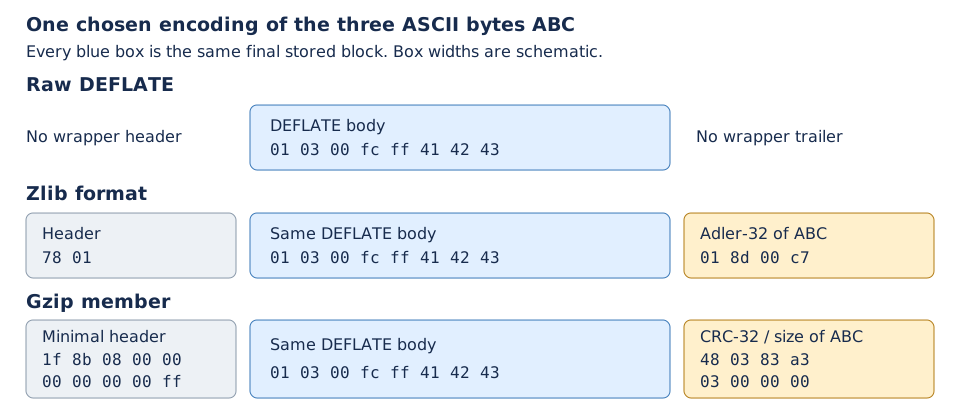
Figure 4.1. Blue: shared body; grey: header; amber: trailer. Widths are schematic, hex values are actual bytes, and colors denote data roles rather than status.
All paths must interpret this block identically. Wrapper proofs locate its boundaries so trailers become neither output nor another block. The format rules define byte meaning; memory bounds separately justify each input read.
4.2 Headers establish the decoder's starting conditions
The paths share block-decoding modes, with potentially different history and window parameters.
flowchart TD
    select["Configured input format"] --> raw["Raw: no wrapper header"]
    select --> zh["Zlib header: method, window and dictionary flag"]
    select --> gh["Gzip header: method, flags and optional metadata"]
    zh -->|"Dictionary requested"| dict["Check identifier; supply initial history"]
    zh -->|"No dictionary"| body["Shared DEFLATE block decoding"]
    dict --> body
    gh --> body
    raw --> body
    body -->|"Raw"| done["Complete"]
    body -->|"Zlib"| za["Check Adler-32"]
    body -->|"Gzip"| gc["Check CRC-32 and size modulo 2^32"]
    za --> done
    gc --> done
Figure 4.2. Normal conceptual paths, not separate C functions. Headers/trailers can span calls; malformed fields branch to errors.
Inside inflate(), HEAD and gzip modes parse headers; TYPE, table and
symbol modes decode; CHECK and LENGTH handle trailers. This source reading is
unfinished by execution proofs. Helpers cover tables (inflate_table()), a
fast segment (inflate_fast()) and history (updatewindow()), not the whole
core. The mode proof follows these boundaries
without rewriting the translation.
4.2.1 A window and an optional initial history
A zlib header announcing 32 KiB must be refused by a decoder limited to 16 KiB.
A header-selected window request instead takes its size from the header.
INFLATE_STRICT also uses the header's maximum distance in body checks; this
option is outside the initial default build.
If both engines start with dictionary bytes ending in AB, a distance-two
reference can use that history before producing two bytes. Without initial
history, that reference is unjustified.
The core's statement therefore takes valid initial history and window conditions, established by actual header/dictionary execution. An Adler-32 dictionary identifier can collide: intended recovery requires matching bytes, not just an equal identifier. See exact window requests and dictionary conditions; state operations covers raw dictionaries.
4.2.2 Gzip metadata has a different destination
Gzip names, comments and extra fields do not change literal, match or Huffman rules. Gzip has no zlib-style preset-dictionary request.
inflateGetHeader() registers caller-owned destinations; later inflate()
parses into them. A name spanning input buffers requires saved progress,
capacity bounds and valid borrowed storage across calls. The
header contract defines these
memory effects alongside byte meaning.
The optional header check stores the low 16 CRC-32 bits over preceding header bytes. Payload CRC starts anew over uncompressed data. Mixing those histories rejects valid input even with a correct CRC routine.
4.3 Follow the bytes into the checksum
For ABC (65, 66, 67), start Adler-32 at s1 = 1, s2 = 0. Add each byte to
s1, then s1 to s2, modulo 65521:
| Prefix processed | s1 |
s2 |
|---|---|---|
| Empty | 1 | 0 |
A |
66 | 66 |
AB |
132 | 198 |
ABC |
199 | 397 |
The result is 397 * 65536 + 199 = 0x018d00c7; zlib writes it most significant
byte first. CRC-32 is 0xa3830348; gzip writes CRC and size least significant
byte first (Figure 4.1). These illustrate the independent
checksum definitions, not an
implementation proof.
flowchart LR
    body["Shared body decoder"] --> a["Output A"]
    a --> bc["Output BC"]
    initial["Checksum of empty payload"] --> ca["Update with A"]
    a -.->|"Exactly these bytes"| ca
    ca --> cabc["Update with BC"]
    bc -.->|"Exactly these bytes"| cabc
    cabc --> compare["Compare with trailer"]
Figure 4.3. Decompression checksums emitted bytes; compression checksums accepted input. Neither uses compressed bytes as its payload.
Updating A, then BC, must equal updating ABC. The invariant equates the
accumulator with exactly the processed prefix: no skipped, duplicate or header
bytes. The Adler-32 and CRC-32 arguments
justify arithmetic/reads; their caller connects those actual ranges to the body
proof's output prefix.
4.4 Output can precede a failed check
Supply Figure 4.1's zlib header and body without the four trailer bytes.
After output ABC, supply 01 8d 00 c6 instead of 01 8d 00 c7.
sequenceDiagram
    participant App as Application
    participant Dec as Decoder
    App->>Dec: Header and stored block for ABC
    Dec-->>App: Output ABC, stream not yet complete
    App->>Dec: Trailer 01 8d 00 c6
    Dec-->>App: Z_DATA_ERROR: checksum mismatch
Figure 4.4. Emitted bytes cannot be retracted; stream validation comes later.
Ordinary validation must reject the mismatch safely and permit cleanup. Matching checksums alone prove neither byte equality nor authenticity: the body relation is also needed. An incomplete trailer instead needs continuation. See the result contract and trailer proof.
4.5 Finishing one member and starting another
In member("ABC") || member("DEF"), || means concatenation. Each gzip member
has its own header, body, checksum and size. inflate() stops at the first
Z_STREAM_END; reset the live decoder and preserve unread input for the next.
first member:  header → body ABC → CRC/size → Z_STREAM_END
                                               │ Reset
next member:  header → body DEF → CRC/size → Z_STREAM_END
Composition must split at the actual member end, restart history/checksum and
join output as ABCDEF. Stopping at the first end loses DEF.
See Reset; the gzip file reader manages
concatenated members. Shared scope and evidence rules
apply throughout.