2. Repetition, symbols and bits
9bf26b964c8a056c · Source at the matching commit ↗ABABABAB suggests an instruction: write AB, then repeat bytes two positions
back. Follow that instruction into a compressed block, preserving its meaning
at each step. Source correspondences below are unfinished under the
shared proof method.
Previous: a complete task · Overview · Next: pausing and continuing
Contents
- 2.1 Turn repeated bytes into a match
- 2.1.1 A copy can read bytes it just produced
- 2.1.2 The compressor must justify its choice
- 2.2 Keep enough recent history
- 2.3 Give frequent symbols shorter codes
- 2.3.1 Read a small code tree
- 2.3.2 Connect the tree to real decoding tables
- 2.4 Choose a block representation
- 2.5 Share meaning between slow and fast decoding
2.1 Turn repeated bytes into a match
One valid description is:
literal A, literal B, match(length = 6, distance = 2)
A literal appends one byte. A match repeatedly reads a specified distance behind the current output. These tokens are not yet their Huffman encoding or complete wire format, nor a prediction of a particular compressor's choices.
2.1.1 A copy can read bytes it just produced
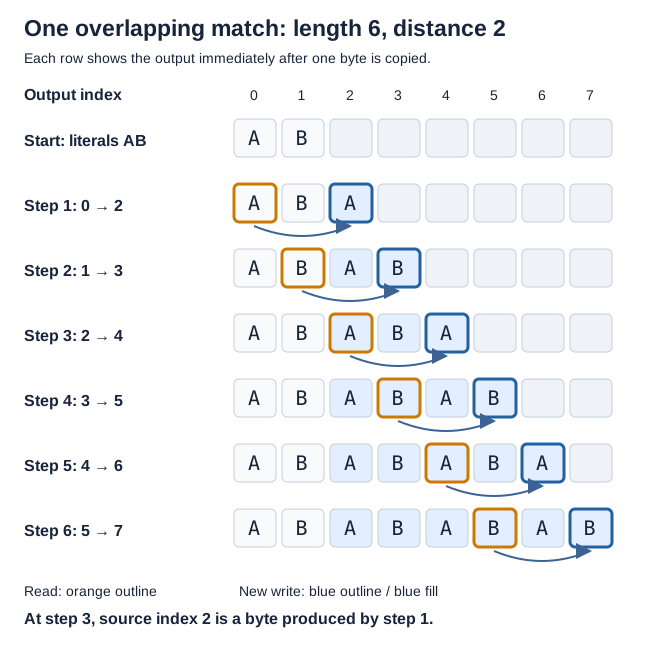
Blue cells were written by this match. Orange outlines mark sources; blue outlines mark destinations. Zero-based indices and arrows show sequential byte-copy order, not a bulk memory copy.
Source 0 supplies destination 2. On the third step, source 2 supplies destination
4, using a byte written by the first step. A disjoint copy from a snapshot of
only the original AB cannot express this operation.
After k steps, the first 2 + k bytes are the corresponding output prefix,
the next source is 2 + k - 2, and six minus k bytes remain. The source
precedes the destination even when ranges overlap. This invariant justifies
both values and initialized reads; actual writable capacity must also hold.
inflate's MATCH mode and inflate_fast perform sequential copies. Their
pointer updates must implement F-match-copy in the
format specification.
The fast-decoder argument treats
overlapping copies in memory.
2.1.2 The compressor must justify its choice
At input position 2, ABABAB matches a distance-2 reference. A compressor can
emit that match or another valid description. Its hash chains help
longest_match locate candidates; strategy loops choose tokens.
A matching hash is only a hint. The proof must relate the chosen distance and length to input bytes, bound candidate reads and chain traversal, and justify emitted tokens. Match-search reasoning need not prove that zlib always finds the longest possible match.
2.2 Keep enough recent history
DEFLATE distances reach 32,768 bytes. A 32 KiB window retains a recent suffix instead of the entire output.
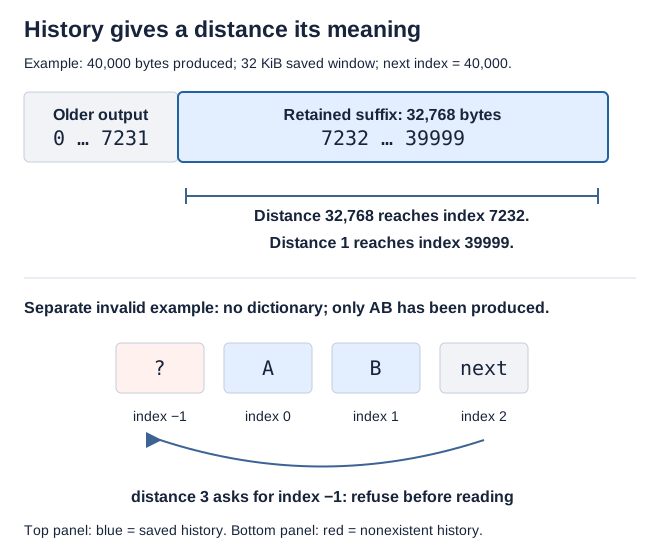
Top: saved history after earlier output was delivered, before any current-call output. Bottom: a separate malformed-input example without a preset dictionary.
After 40,000 bytes, 40000 - 32768 = 7232 is the oldest retained index.
Distance 32,768 reaches it; distance 1 reaches the newest byte. Physical ring
slots must continue to denote that logical suffix through wrapping or sliding.
With only AB available, distance 3 asks for a nonexistent earlier byte.
Ordinary sane-distance decoding must reject it without an invalid read.
Malformed input is thus covered, rather than excluded by a valid-data premise.
A real match can read saved history, current-call output, or both. Window size alone does not justify those reads. Smaller windows and optional strict-distance checking complicate acceptance; buffer splits can matter. Exact conditions remain in the history specification and decoder invariant.
2.3 Give frequent symbols shorter codes
Huffman coding represents symbols with bit strings called codewords. Shorter codewords for frequent symbols can reduce the total bit count. Encoder and decoder must use the same code.
2.3.1 Read a small code tree
Use a toy four-symbol alphabet with frequencies A:4, B:2, C:1, D:1.
Repeatedly combine the two least frequent nodes. This illustrates Huffman
coding, not DEFLATE's fixed table, complete alphabet or a complete block.
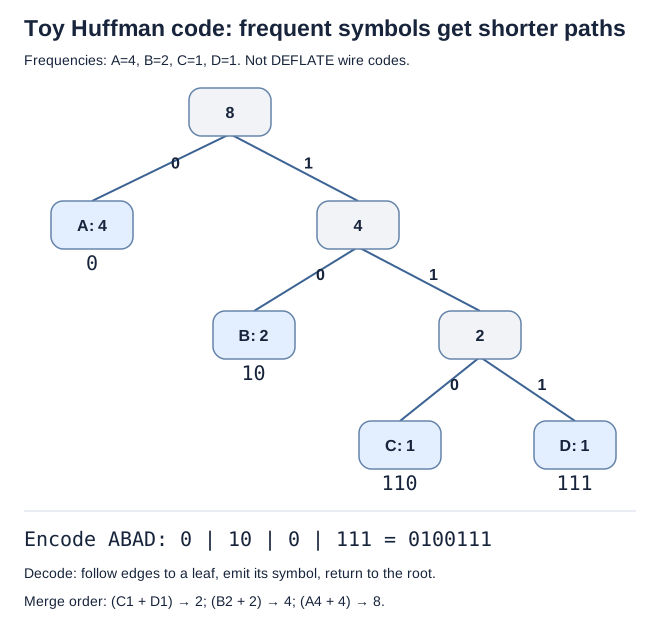
Symbol labels give frequencies. Follow 0 left and 1 right; a leaf ends a codeword.
ABAD becomes 0 | 10 | 0 | 111, or 0100111. Decoding repeatedly starts
at the root: 0 reaches A, 10 B, then 0 A and 111 D. No leaf is another's
ancestor, so no complete codeword begins another. This prefix-free property
makes symbol boundaries unambiguous.
For all eight symbols, the payload cost is
4×1 + 2×2 + 1×3 + 1×3 = 14 bits, versus 16 for two bits per symbol.
This excludes code-description cost: saving two payload bits alone does not
make a dynamic block smaller.
2.3.2 Connect the tree to real decoding tables
DEFLATE has literal/length and distance alphabets. Literal/length symbols denote bytes, end-of-block or lengths; some lengths and distances need extra bits. A length-12 match uses symbol 265, base 11 plus extra value 1. Distance 2 uses symbol 1 without extra bits. Their codewords depend on the selected block code.
Dynamic blocks transmit code lengths; canonical assignment derives codewords
from lengths and symbol order. inflate_table builds lookup tables instead
of requiring a tree walk for each symbol.
The proof must show both that lengths describe an admitted code, including invalid-input handling, and that each initialized entry returns the prescribed symbol, extra-bit count or error. Bounded access alone does not establish meaning; see table construction.
Toy bit strings show codeword order only. Real packing gives numeric fields and Huffman codewords different bit-order rules, defined by the bit-order specification.
2.4 Choose a block representation
A stored block carries bytes directly; fixed blocks use predefined codes; dynamic blocks describe their codes first. One DEFLATE stream can mix all three.
flowchart TD
    bytes["Input bytes for a block"] --> choose["Compare available representations"]
    choose --> stored["Stored: length fields and original bytes"]
    choose --> fixed["Fixed: predefined codes and coded symbols"]
    choose --> dynamic["Dynamic: describe codes and code symbols"]
    stored --> meaning["Same represented input bytes"]
    fixed --> meaning
    dynamic --> meaning
Representation choices, not statement-by-statement C control flow. Costs include headers, extra bits and alignment.
A short block may not repay a dynamic description's cost; poorly compressible
data may favor stored form. Every choice must preserve input meaning, and
capacity bounds must include overhead. _tr_flush_block selects forms in
trees.c; see tree construction and emission.
Dynamic headers require a second level of codes:
flowchart LR
    small["Header describes code-length code"] --> lens["Decode literal/length and distance code lengths"]
    lens --> tables["Construct payload decoding tables"]
    tables --> payload["Decode literals, lengths and distances"]
    payload --> output["Reconstruct bytes"]
The code-length code describes payload codes, not original bytes directly.
If two length-array slots remain, repeating zero three times is invalid. Rejecting before the third write connects format validity to a memory bound. The dynamic-block specification defines exact counts and repeat rules.
2.5 Share meaning between slow and fast decoding
inflate decodes in its state machine or calls inflate_fast when input,
output and buffered-bit margins suffice. Both paths occur under default
parameters; small buffers do not select a different format.
flowchart TD
    entry["Same decoded prefix, history, tables and remaining bits"] --> room["Enough input/output room and bit margin?"]
    room -->|"yes"| fast["Fast decoding segment"]
    room -->|"no"| slow["Main state-machine decoding"]
    fast --> next["Extend the prefix according to the same symbols"]
    slow --> next
    next --> saved["Preserve history, unread bits and cursor accounting"]
    saved --> entry
An intended shared invariant. Actual paths can suspend, reach block boundaries, finish or fail.
The main proof derives helper premises from execution and uses a proved result covering actual returned pointers, bits and output. The main-decoder and fast-decoder arguments develop this connection. Streaming next follows what must survive a pause.