3. Pausing and continuing a stream
cb5db7c6addcacb0 · Source at the matching commit ↗To deliver ABABABAB through three-byte output buffers, a decoder must pause
and continue. Streaming keeps the task's state across calls. Following that
state explains what the continuation proof must preserve.
Contents
- 3.1 Where the bytes and the memory live
- 3.2 Three calls, one decoded result
- 3.2.1 Preserve the input that remains
- 3.2.2 Account for the same execution
- 3.3 A pause can occur inside a match
- 3.4 A buffer boundary is not a format boundary
- 3.5 Progress, completion and errors
3.1 Where the bytes and the memory live
The application owns z_stream and its buffers. next_in points at avail_in
unread compressed bytes; next_out points at avail_out writable bytes.
Calls advance these pointers and reduce their counts by the amounts used.
flowchart LR
    subgraph caller["Caller-owned storage"]
        input["Readable input bytes"]
        stream["z_stream: pointers and counts"]
        output["Writable output space"]
    end
    subgraph library["Library-owned storage"]
        state["Mode, buffered bits, tables, checksum"]
        window["Retained output history"]
    end
    stream -->|"next_in / avail_in"| input
    stream -->|"next_out / avail_out"| output
    stream -->|"state pointer"| state
    state --> window
The arrows denote references. They do not transfer ownership of caller buffers.
Replacing an output buffer retains the decoder's tables and history. Its stream invariant connects that history to decoded bytes and records the bounds and ownership needed to continue. Initialization must establish it; permitted calls must preserve it. The shared proof method explains framing and why helper contracts cannot be assumed.
This source reading is unfinished by proof. The shared contracts give exact buffer, alias and lifetime conditions. Init allocates state; later calls may allocate a history window. Both allocation-failure paths need cleanup arguments.
3.2 Three calls, one decoded result
This hand-constructed zlib stream stores the eight ASCII bytes ABABABAB.
The extra EE exposes the stopping position.
78 01 | 01 08 00 F7 FF | 41 42 41 42 41 42 41 42 | 09 3C 02 0D | EE
header  stored-block     A  B  A  B  A  B  A  B    Adler-32      tail
        header
This encoding need not be the default compressor's choice. See encoding for block choices and wrappers for the header and check value.
After inflateInit succeeds, use Z_NO_FLUSH and three-byte output buffers.
Supply nine input bytes, then the remaining eleven once those are exhausted.
Call 3 keeps unread input. Deliver each output before reusing its buffer.
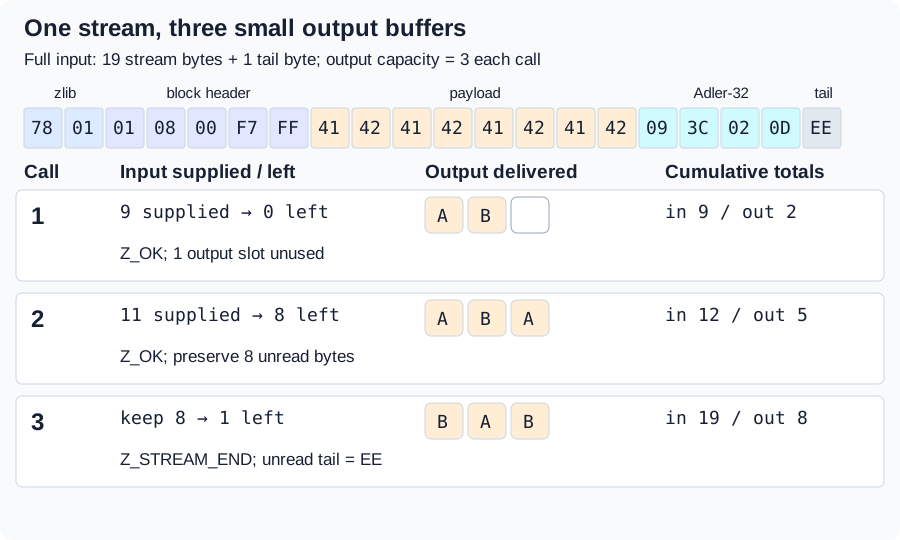
Blue: supplied input; amber: produced bytes; gray: unread input. Colors denote data roles, not proof status.
| Call | Input available before | Consumed | Produced | Input left | Output room left | Return |
|---|---|---|---|---|---|---|
| 1 | 9 | 9 | AB (2) |
0 | 1 | Z_OK |
| 2 | 11 | 3 | ABA (3) |
8 | 0 | Z_OK |
| 3 | 8 | 7 | BAB (3) |
1 | 0 | Z_STREAM_END |
Cumulative (total_in, total_out) is (9, 2), (12, 5), then (19, 8).
Call 3 consumes three payload and four trailer bytes. Output joins to
ABABABAB; EE remains unread. A finite run of the pinned C confirmed these
values: example evidence, not a general proof.
3.2.1 Preserve the input that remains
Call 2 leaves eight bytes needed to finish. Replacing them loses input. Refill
only when avail_in == 0, or move/append data while preserving unread bytes and
their correct pointer and count.
sequenceDiagram
    participant A as Application
    participant D as Decoder
    A->>D: First 9 input bytes, output room 3
    D-->>A: AB, no input remains, Z_OK
    Note over A: Deliver AB, refill exhausted input
    A->>D: Remaining 11 input bytes, output room 3
    D-->>A: ABA, 8 input bytes remain, Z_OK
    Note over A: Deliver ABA, keep unread input
    A->>D: Same remaining input, fresh output room 3
    D-->>A: BAB, EE remains, Z_STREAM_END
The application drives inflate and manages buffer lifetimes between calls.
3.2.2 Account for the same execution
For one actual returned heap, consumed input c and produced output p obey:
c = avail_in_before  - avail_in_after
p = avail_out_before - avail_out_after
next_in_after  = next_in_before  + c
next_out_after = next_out_before + p
For valid input in an ordinary run, newly written bytes extend the decoded prefix. Counter and output theorems must describe that same execution. The decoder argument connects mode proofs to the common return path.
Normal totals wrap at C unsigned widths; this example does not wrap. After a late window-allocation failure, pointers can reflect progress while final total/checksum updates are skipped. See the exact accounting contract.
3.3 A pause can occur inside a match
After output AB, a length-six, distance-two match needs six output slots.
With three slots per call, it spans two calls.
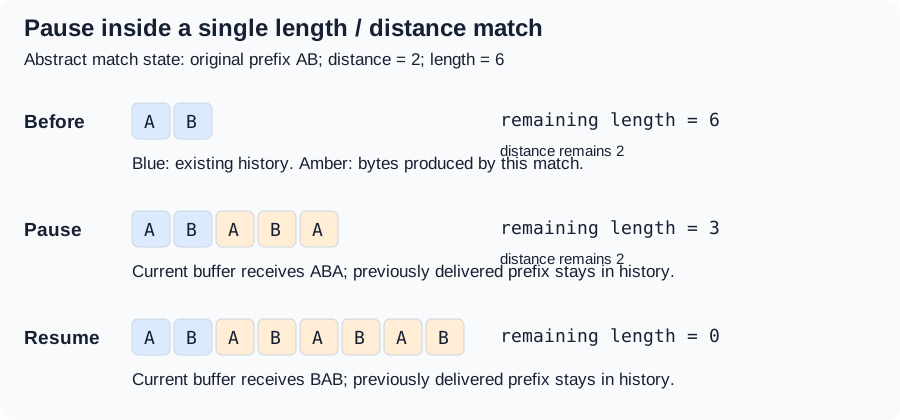
An abstract match-state example, not a compressed-byte or actual return trace.
After writing ABA, retain distance 2, remaining length 3 and history for
BAB. Once the application reuses its old output buffer, continuation must
read valid retained history rather than overwritten caller storage.
The proof therefore connects window contents, current output, valid distance
and remaining match. A numeric remaining length alone cannot justify source
reads. C's MATCH state and return-time window update implement this mechanism,
unfinished by the continuation arguments.
3.4 A buffer boundary is not a format boundary
A symbol can span input chunks. A decoder can also consume a byte but retain
unused bits. Thus avail_in == 0 leaves no unread caller bytes, yet buffered
bits or pending output may remain.
flowchart LR
    first["Chunk A: first bits of a symbol"] --> saved["Retain bits and decoding mode"]
    saved --> second["Chunk B: remaining bits"]
    second --> symbol["Complete symbol"]
    symbol --> partial["Output fills during its match"]
    partial --> resumed["Retain remaining match; resume with room"]
Input may split a symbol; output may split its expansion. Meaning is unchanged.
The proof must lose or duplicate neither bits nor output across these cuts. Fast and ordinary paths share the same relations; both can occur under default configuration as buffers change. The fast decoder argument gives entry margins and the returned bit-buffer relation.
3.5 Progress, completion and errors
stateDiagram-v2
    [*] --> Active: successful init
    [*] --> InitFailed: init fails and cleans up its attempt
    InitFailed --> [*]: no live decoder to continue
    Active --> Active: progress or legal rebuffering
    Active --> Waiting: cannot progress with current buffers
    Waiting --> Active: provide input or output room
    Active --> Complete: Z_STREAM_END
    Active --> Error: detected data or allocation failure
    Active --> Released: End to abandon
    Waiting --> Released: End to abandon
    Complete --> Released: End
    Error --> Released: End
    Released --> [*]
Waiting is an application condition, not a C mode. This End-only cleanup view omits the reset and recovery protocols.
Z_BUF_ERROR can mean no progress: provide input or room before retrying a
blocked request. EOF before Z_STREAM_END is not completion. Output can precede
a failed trailer check.
Compression uses Z_NO_FLUSH, then Z_FINISH until Z_STREAM_END, adding no
new input after the first finish request. See flushes.
The shared lifetime obligation composes actual init, calls, rebuffering and End. It includes failed-init cleanup and safe End after data or window-allocation errors; the diagram does not prove it.