5. Reuse, checkpoints and controlled changes
682afeafd349c983 · Source at the matching commit ↗A server reuses storage for independent messages; a viewer saves progress to revisit a document. Reset and Copy serve these different needs. Both change what future calls can do with the stream state. Source effects below are unfinished by execution proofs. The shared method explains how operation-specific invariants compose.
Contents
- 5.1 Reuse storage for another message
- 5.2 Save a checkpoint with Copy
- 5.2.1 Equal progress, independent ownership
- 5.3 Start with an agreed dictionary
- 5.4 Choose when a compressor exposes a boundary
- 5.4.1 Finish, reset and parameter changes
- 5.5 Inspect or recover a special state
5.1 Reuse storage for another message
After delivering ABAB from message A, a decoder can process independent B.
inflateReset discards A's progress and history, retaining reusable resources
and the requested format/window configuration. The caller supplies B's buffers.
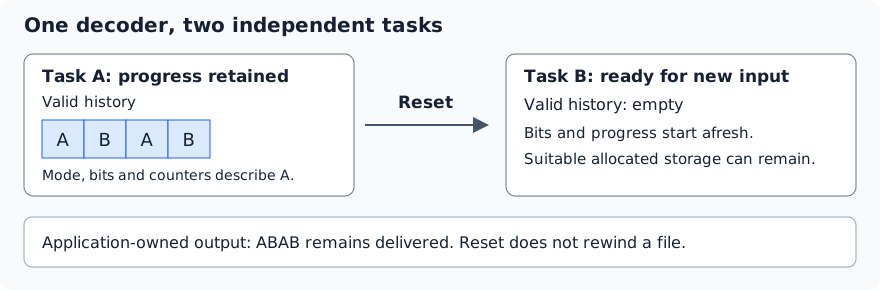
Blue cells denote valid history; the white application box denotes delivered data. Reset neither erases delivered bytes nor moves a file's read position. The proof must make old window contents logically unavailable to future matches, even if storage remains allocated, and account for a window freed when restoring the requested size.
inflateReset2 also selects a wrapper/window request, with a documented refusal
for invalid values. deflateReset similarly discards compression progress and
clears match history. Reset may abandon unfinished work; it does not certify
completion. Undocumented *ResetKeep entries retain history: a compressor using
old matches need not produce a stream decodable from empty history. Their
contracts define that protocol.
Exact ordinary reset effects are in the
inflate and
deflate contracts.
5.2 Save a checkpoint with Copy
Imagine decoder A paused after AB, before a match producing ABABAB.
This conceptual position need not be a particular inflate return point.
inflateCopy(B, A) lets B resume from the same position/history while A continues.
A useful checkpoint also preserves or recovers the unread compressed input and
its position. A byte offset alone omits buffered bits, tables, history and any
partially decoded operation.
5.2.1 Equal progress, independent ownership
flowchart TD
    CP["Successful Copy at position P"] --> A["Decoder A at P"]
    CP --> B["Decoder B at P"]
    A --> AS["A-owned state and optional window"]
    B --> BS["B-owned state and optional window"]
    A -. "borrowed pointer" .-> IN["Caller input bytes"]
    B -. "borrowed pointer" .-> IN
    A -. "borrowed pointer if registered" .-> H["Caller gzip header storage"]
    B -. "borrowed pointer if registered" .-> H
Solid edges show independent internal ownership; dotted edges show borrowed caller storage. Output pointers are copied too: provide suitable destinations before either continuation writes. Shared header storage must remain valid for both histories. The proof must preserve the decoding position while separating mutable internal storage: progressing or ending A cannot modify/free B's state. Each needs its own End. Static read-only tables may be shared; pointers into copied internal tables must point into the copy.
If allocation fails partway, free the attempt's allocations, preserve the source
and account for the unusable destination. The
Copy contract requires a distinct,
writable, non-live destination. deflateCopy likewise branches compression,
for example to try alternative continuations; already published bytes remain
the application's responsibility. Its contract
and ownership argument cover the different internal storage.
5.3 Start with an agreed dictionary
Short messages may share vocabulary. With preset history AB, a conceptual
body could begin “copy 6 bytes from distance 2”, producing ABABAB without
delivering the dictionary itself. This illustrates the format, not a prescribed
compressor token choice.
sequenceDiagram
    participant C as Compressor
    participant App as Application
    participant D as Decoder
    App->>C: SetDictionary with agreed bytes
    App->>C: deflate calls with message input
    C-->>App: zlib header with dictionary identifier, then body
    App->>D: inflate with those compressed bytes
    D-->>App: Z_NEED_DICT and expected identifier
    App->>D: SetDictionary with matching bytes
    D-->>App: Z_OK
    App->>D: Resume inflate
    D-->>App: Message output using initial history
The proof connects installed history to the compressor's actual dictionary. Equal Adler-32 identifiers do not imply equal bytes. Retain the correct bounded suffix and justify matches reaching before the message's output; the copy example explains how new bytes extend a match.
Zlib requests the dictionary through Z_NEED_DICT. Raw mode permits installation
at call boundaries without an identifier check; gzip has no preset-dictionary
path. Wrong dictionaries and allocation failures have distinct continuation
rules in the dictionary contract.
5.4 Choose when a compressor exposes a boundary
A receiver may need to decode bytes sent so far without ending the message.
Z_SYNC_FLUSH exposes such a boundary while allowing later matches into earlier
history. Completed Z_FULL_FLUSH also clears match history, permitting restart
there with suitable decoder state.
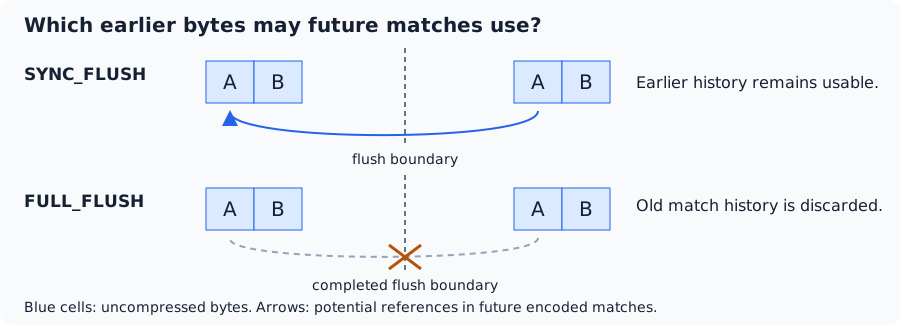
Arrows are possible future references, not flush-time memory copies. Full flush neither starts a new zlib/gzip wrapper nor ends the stream; frequent full flushes can reduce compression savings. Its proof must link accepted input, pending bits and published bytes, and exclude future matches into discarded history. A marker does not make an arbitrary suffix independently wrapped and valid.
If output fills before a flush completes, retry the same request with more room and the updated input pointers/counts. Exact completion and marker-space rules are in the flush contract.
5.4.1 Finish, reset and parameter changes
For Z_FINISH, keep supplying output room until Z_STREAM_END, adding no new
input to the finish operation while accounting for its unconsumed input. End
frees resources; Reset prepares another task.
deflateParams may flush a block under old level/strategy settings before
installing new ones. On Z_BUF_ERROR, settings stay unchanged but consumed input
and produced output remain progress. Preserve that accounting across retries.
See the parameter contract and
block-publication argument.
5.5 Inspect or recover a special state
inflateSync searches damaged input for a possible full-flush marker. The same
pattern can occur elsewhere; finding it guarantees neither a valid suffix nor
whole-stream integrity.
flowchart LR
    E["Detected data error"] -->|"Abandon old task"| R["Reset; supply a new stream"]
    E -->|"Attempt partial recovery"| S["Sync search with readable input"]
    S -->|"No marker; provide more input"| S
    S -->|"Possible marker found"| C["Resume decoding under recovery rules"]
    E -->|"Release resources"| X["End"]
    C -->|"No guarantee of valid suffix"| E
These are selected workflows, not all representable states. During Sync search,
ordinary inflate cannot replace the search call. Recovery can disable trailer
validation; the contract states that scope.
| Need | Entries and proof consequence |
|---|---|
| Supply a bit fragment | inflatePrime supplies bits for raw-start or reported-boundary workflows. deflatePrime prefixes raw output before the first compression call after init/reset. Include the bits in the format relation. |
| Inspect progress/buffering | inflateMark, inflateCodesUsed, deflatePending, deflateUsed: justify the reported quantity and permitted writes. |
| Read history | *GetDictionary: bound the destination and distinguish current history from the preset dictionary. |
| Control validation | inflateValidate: identify integrity checks enabled at completion. |
The C does not enforce every raw/timing premise in focused Prime contracts. Outside such a premise is not automatically C UB or a clean refusal; use the contract conventions. Broader public goals retain their domains. The call-history method supplies the common composition argument; progress holds its evidence. Next: application interfaces.