6. Choosing an application interface
6d7457983c08864e · Source at the matching commit ↗Decoding eight bytes, copying a large archive to a destination and reading a line near a gzip file's end share byte meaning but use different transfer and resource protocols. Their source behavior is unfinished by execution proofs; shared composition rules apply to every interface.
Contents
- 6.1 One buffer operation contains a stream lifetime
- 6.2 Callbacks let the decoder request input
- 6.3 A gzip handle connects the codec to a file
- 6.4 Seeking names a position in the original data
- 6.5 Independent checksum operations
6.1 One buffer operation contains a stream lifetime
compress accepts a complete source and destination capacity, managing an
ordinary compressor internally. uncompress manages an ordinary decoder.
Both use zlib format, without gzip/raw selection.
sequenceDiagram
    participant A as Application
    participant U as Buffer utility
    participant E as Ordinary stream engine
    A->>U: Source bytes, destination capacity
    U->>E: Init
    alt Initialization succeeds
        loop While the engine returns Z_OK
            U->>E: Provide available slices, process
            E-->>U: Advanced cursors, result
        end
        U->>E: End, including processing failure
        U-->>A: Used destination length, mapped result
    else Initialization fails
        U-->>A: Initialization error
    end
Wider lengths are sliced to fit engine availability fields. The streaming discipline is hidden, but its cursor and cleanup obligations remain in the utility proof.
Eight-byte example. For ABABABAB, let compression produce m bytes.
Headers/trailers and block descriptions can make m exceed eight. The default
formula gives compressBound(8) = 21; adequacy requires connecting that number
to actual output size. Compressed bytes and m can vary across configurations.
Decompression instead needs a separate bound on original size; compressed length alone does not give destination capacity. A valid stream representing eight bytes with a four-byte destination must stay within those four bytes, including on buffer failure. Output may already have changed.
Utilities map engine completion Z_STREAM_END to Z_OK. uncompress2 reports
consumed input and output length, and maps dictionary requests and certain
incomplete-input cases to Z_DATA_ERROR. The contracts
state exact results and scalar-storage requirements; the
proof guide covers local state, conversions and bounds.
6.2 Callbacks let the decoder request input
With inflateBack, the decoder invokes input/output functions during one call.
It has a separate raw DEFLATE implementation in infback.c, not a wrapper
around ordinary inflate.
sequenceDiagram
    participant A as Application
    participant B as Callback decoder
    participant I as Input callback
    participant O as Output callback
    A->>B: BackInit with caller-owned window
    A->>B: Back with callbacks
    loop Until one raw stream ends or a failure occurs
        B->>I: Request the next readable input slice
        I-->>B: Pointer and count, zero means no input
        Note over B: Decode into the window, retain history
        B->>O: Read this produced window slice
        O-->>B: Zero for success, nonzero for failure
    end
    B-->>A: Completion or error, unread input suffix
    A->>B: BackEnd releases internal state
    Note over A: Caller can now release its window
This assumes successful init and shows a possible cycle, not one input call per output call. Initial input may delay the first callback. Output chunks are at most one window, including a final nonempty partial chunk. Because the window also retains history, callbacks must not overwrite/free it. Read or copy each slice before returning; the decoder may then reuse it.
Copying to a destination. Input callbacks supply archive chunks; output callbacks copy decoded slices to application storage. Safety requires readable input until permitted replacement, bounded window writes and adequate callback destinations. Callbacks must return, and supplied input history must be bounded: a function-pointer type guarantees neither condition.
Input exhaustion/output refusal can return Z_BUF_ERROR. Malformed bytes can
return Z_DATA_ERROR after output; a final output refusal does not replace an
already selected format error. End uses inflateBackEnd. Each new inflateBack
call starts an independent raw stream, rather than resuming after an input pause.
The callback contracts state this focused domain; the proof guide connects calls to window ownership. The application handles any enclosing zlib/gzip wrapper.
6.3 A gzip handle connects the codec to a file
gzopen creates a handle, gzread/gzwrite transfer application bytes and
gzclose releases it. Buffers and codec initialization are lazy: open success
does not guarantee later allocation or I/O success. These calls rely on explicit
external-world semantics.
flowchart LR
    file["File: compressed bytes"] -->|"OS read"| input["Buffered input"]
    input --> decoder["Gzip decoding"]
    decoder --> output["Decoded bytes, buffered or direct"]
    output -->|"gzread"| app["Application"]
    app -->|"gzwrite"| encoder["Buffered input and gzip encoding"]
    encoder -->|"OS write"| sink["File: compressed bytes"]
Read/write are separate modes; buffering decouples the arrows. gzwrite can
accept bytes before any file write, followed by failure during flush/close.
The proof must distinguish accepted bytes, encoded bytes and successful I/O.
gzread handles concatenated gzip members internally; ordinary inflate
completes one member and requires caller action. Ordinary file reading can also
return recognized non-gzip input unchanged. Its proof therefore includes
transparent copying as well as decoding.
Members containing AB and CD. Repeated reads can deliver ABCD across
arbitrary buffer boundaries, preserving each member's checks and allocations.
Returned data may precede a later error. EOF, truncation, corruption and OS
failure have distinct API results. Cleanup covers lazy
init failure, partial I/O and close after failure; freeing resources cannot
require a successful final write. See the gzip argument.
6.4 Seeking names a position in the original data
gzseek(file, 100000000, SEEK_SET) names byte 100,000,000 in uncompressed
data. gztell gives the logical next-transfer position; gzoffset gives the
compressed-file offset, subtracting unread buffered input in read mode.
There is no fixed conversion between them.
Reading. Seeking backward from logical byte 150,000,000 to 100,000,000 may rewind, decode and discard that prefix. Some work is deferred until a read, which can make positioning much slower than a plain file seek.
flowchart LR
    current["Logical position 150,000,000"] -->|"Backward seek requested"| start["Rewind to stream start"]
    start -->|"Decode and discard prefix"| target["Logical position 100,000,000"]
    target -->|"Next read delivers bytes"| next["Application output"]
Forward seeks can consume decoded buffers or schedule a skip; transparent input
has a direct-file path. Relate processed position plus pending skip to the
observed position, with representable offset arithmetic. SEEK_END is unsupported.
Writing. Write ABC, seek to logical offset 6, then write D: the three
intervening bytes are zeros compressed as data.
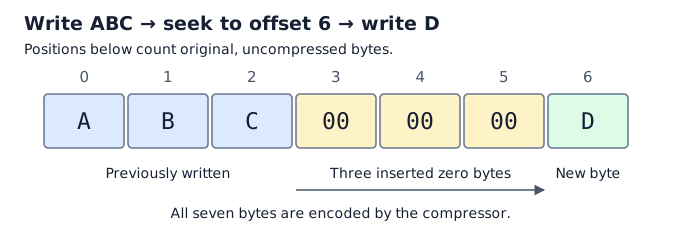
Colors distinguish existing bytes, zeros and new input, not proof coverage.
Writing cannot seek backward to patch A. Zero-fill can wait until write/close;
carry its pending distance across calls and later I/O failure. See
seek, position queries
and the position argument.
Decoder checkpoints are a separate mechanism.
6.5 Independent checksum operations
adler32/crc32 can update a small state over byte slices without any codec or
file handle. To combine independently processed X and Y, use both checksums
and the length of Y to obtain the checksum of X || Y. The length matters;
combining checksums is not ordinary addition.
Prove this composition alongside the implementation's bounds and integer behavior. See contracts, Adler-32 and CRC-32. Wrapper integration stays in chapter 4; accepted evidence stays in progress.