1. A complete compression and decompression task
1ccab2fe31812115 · Source at the matching commit ↗Overview · Next: How bytes become codes
An application stores the eight bytes ABABABAB and recovers them later.
Following this task connects the caller's bytes, the library's output and the
resources used. Implementation behavior below is unfinished by execution
proofs under the shared scope and method.
Contents
- 1.1 Follow eight bytes
- 1.2 Start, process and release
- The successful route
- Failure and abandonment
- 1.3 Accepted input and published output
- 1.4 Too little room or damaged data
- 1.5 Connect both engines to byte meaning
1.1 Follow eight bytes
Our hexadecimal bytes are 41 42 41 42 41 42 41 42. zlib treats them as bytes,
just as it would image data, serialized records or embedded zeros.
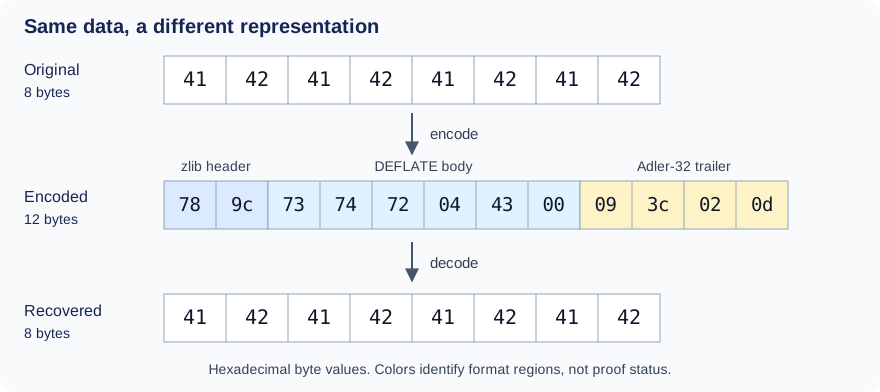
The middle row is one valid zlib-format encoding, not a promise of identical output across versions, configurations or call schedules. Encoding and wrappers explain its body, header and trailer.
Twelve bytes represent eight: coding and wrapper overhead can outweigh savings. Capacity therefore needs a proved bound. Several representations can encode the same input; correctness uses independent format relations, not equality to one preferred compressed string.
This example selects the default zlib wrapper, no preset dictionary and ordinary validation. Wider domains remain in the configuration specification.
1.2 Start, process and release
The successful route
Create a compressor with deflateInit and Z_DEFAULT_COMPRESSION. Provide
buffers, call deflate, and request Z_FINISH once all input has been supplied.
Z_STREAM_END reports completion; deflateEnd releases internal resources.
Separately, create a decoder with inflateInit, feed it the encoded bytes,
call inflate until completion, and release it with inflateEnd.
Initialization prepares state without compressing or decompressing.
Exact call conditions are in the compression
and decompression contracts.
The engines need not share a program: a producer can write today and an unrelated consumer decode later. The format is their agreement.
Failure and abandonment
Failed initialization must undo every allocation made by that attempt. Successful initialization transfers ownership of internal resources to the stream until End.
flowchart TD
    fresh["Caller owns stream record and buffers"] --> init["Initialize engine"]
    init -->|"Success: internal resources acquired"| live["Live engine"]
    init -->|"Failure: undo this attempt's allocations"| none["No new engine-owned resources"]
    live -->|"Process more data"| live
    live -->|"Complete"| complete["Completed, still owns internal resources"]
    live -->|"Abandon or handle an error: End"| released["Internal resources released"]
    complete -->|"End"| released
Ownership through a task, rather than an exhaustive API transition graph. The caller retains its record and buffers.
An application can abandon decoding after an error or because it no longer needs the data. End releases resources without processing the remainder. For compression, End also discards pending output. It can report premature abandonment even after freeing internal storage; see the end contract.
Recovering eight bytes alone therefore does not establish the lifetime claim. Initialization establishes ownership, calls preserve it, and End frees each owned allocation once. The shared proof method explains this composition.
1.3 Accepted input and published output
A call may accept only ABA from the supplied ABABABAB. The remaining BABAB
must be presented again. Updated input pointers and counts identify accepted
bytes; updated output pointers and counts identify written bytes.
The compressor can retain work internally, so accepted and published byte counts need not correspond in the same call. Streaming follows the buffer boundaries and saved state.
The argument records accumulated accepted input and the published encoding
prefix. Before completion, that prefix need not be a complete decodable stream;
it must be related to retained state. After finishing, the full encoding must
describe exactly ABABABAB.
1.4 Too little room or damaged data
Give the decoder only seven output slots. The eighth decoded byte must wait for more room, never be written outside the range. Streaming explains continuation.
| Change to the example | What the argument must account for |
|---|---|
| Seven output bytes of capacity | Writes stay within the range; completion cannot omit the eighth byte. |
| Only the encoding's beginning is available | More input may be needed; a missing suffix alone does not establish malformed data. |
The last byte changes from 0d to 0c |
The body can still yield ABABABAB, but enabled trailer validation must reject the changed check value. |
| An internal allocation fails | The error, retained state and cleanup must match that failure path. |
Output can precede a bad-trailer error. Wrappers explains why published bytes do not certify whole-stream validation.
Malformed data remains in the safety domain. Invalid pointers have separate caller obligations; expecting an error cannot make them safe. See defined refusals and memory obligations.
Whole-task completion needs sufficient input/output opportunities and the required finish requests. Repeating an unproductive request cannot ensure it. Per-call termination must separately exclude exhausted loop fuel.
1.5 Connect both engines to byte meaning
A round trip is insufficient as the sole correctness statement: two engines could agree with each other while violating the interoperable format.
flowchart LR
    original["Original bytes: ABABABAB"] --> compressor["Actual compressor execution"]
    compressor --> encoded["Emitted bytes"]
    encoded --> decoder["Actual decoder execution"]
    decoder --> recovered["Recovered bytes: ABABABAB"]
    format["Independent format meaning"] -->|"Encoding represents original input"| encoded
    format -->|"Decoding agrees with represented bytes"| recovered
The upper route executes the task. The lower connections independently relate actual translated buffers and executions to byte meaning. A model that assumes the desired behavior does not establish either connection.
The compressor argument follows accepted input through symbols, bits and published bytes; the decoder argument follows supplied bits through tables and history copies into output. Technical details belong to the compressor and decoder guides. Helper premises must follow from initialization and preceding execution.
The shared acceptance rules cover safety, resources and evidence. Finite example tests can expose disagreement; they do not prove universal claims.
Continue with how bytes become codes: the mechanisms inside the encoding, and the invariants each mechanism needs.